Railay / Tonsai
Railay possesses the most beautiful tropical beach topography in Thailand |

Introduction
|

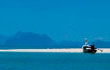
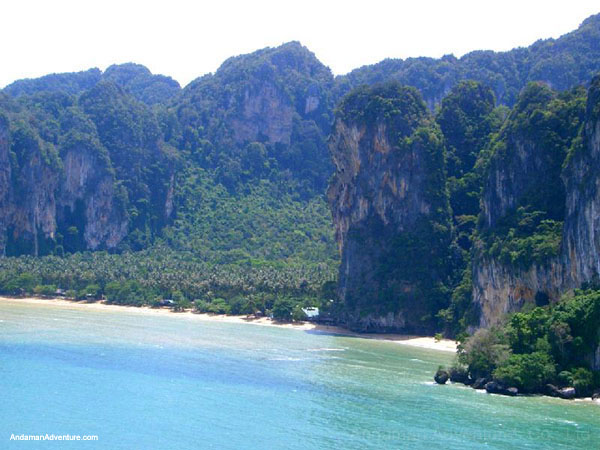
If there is a more beautiful place in southeast Asia, it has so far eluded us. Cut off from the rest of Thailand by towering karts cliffs, Railay is a peninsula made up of four beaches, each separated from its neighbour by huge cliffs. Although not an island, access is by boat only, and there are no motor vehicles. |

Whilst Railay is southeast Asia’s premier rock climbing destination, it is far from being a destination that only climbers will enjoy.
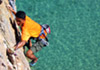
Home to two of southeast Asia’s finest beaches, it is also a great place to do nothing much except soak up the rays and the peaceful atmosphere, admire the scenery and maybe puzzle at the ant-sized antics of the climbers battling up the rock-faces.
If you are one of those for whom relaxation is aided by watching other people do energetic things, Railay is the place for you.
Primarily a family and romance destination, Railay is also a good if rather expensive choice for backpackers, who will enjoy the wholesome party scene on East Railay beach.
|
|
|
Railay is crowded during high season, and many people choose to stay in nearby Ao Nang, and visit Railay on day-trips.
|
The cliffs that cut the Railay/Tonsai pensinsula
off from the rest of Thailand free it from all motor traffic and
protect the unique landscape.
Railay possesses arguably the most beautiful tropical seascape in the entire world, and certainly Thailand's most dramatic. |
|
Beaches
Phra Nang Beach
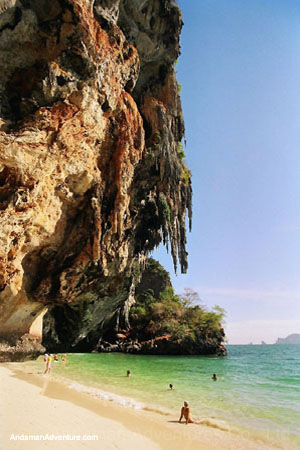
This is arguably the finest beach in Thailand, if not southeast Asia. A broad strip of dazzlingly white sand with massive cliffs framing each end of the beach, Phra Nang has just enough facilities: roast chicken and salad lunches cooked on the beach, massage ladies and people inconspicuously selling cold drinks. It still thankfully lacks all the things that spoil a beach: pollution, traffic, noise, over-enthusiastic hawkers, jet-skis and lager louts.
| The only resort on the beach is the exclusive and unobtrusive Rayavadee, but you don’t have to stay there to enjoy the beach. You can reach Phra Nang beach on foot from anywhere on Railay or by longtail boat from Ao Nang: just bring a beach towel and a book, and you won’t have to move till it’s time to leave. If you get bored of watching the climbers falling off the surrounding cliffs onto the sand, then maybe wander across to Phra Nang cave and admire or envy all the 2 metre long, red-tipped phalluses there. |
 |
 |
If you feel like stretching your legs, then maybe take the short stroll to West Railay beach, from where you can take a longtail boat back to Ao Nang. There are more pristine beaches in Thailand (Koh Jum and Koh Lao Liang spring to mind), but none that so perfectly balance natural beauty with exactly the right level of facilities. |
West Railay Beach
 |
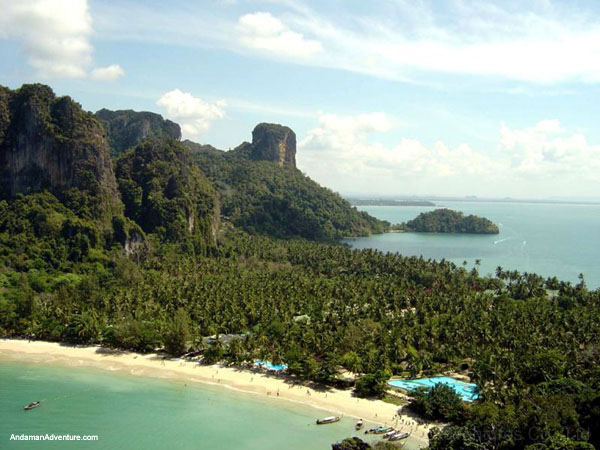
Whereas Phra Nang beach has a quiet, cosy feel, West Railay beach is more majestic. A long, broad strip of white sand framed at each end by huge cliffs, West Railay has more activities going on than does Phra Nang. On most days in high season there are games of football and beach volleyball, in which visitors are welcome to join in.
|
| The Railay Bay Resort is blessed with an unbeatable location at the beach’s southern end and is a great place to stay, if you can put up with the notoriously slow restaurant service and most atypically depressed-looking staff. The nearby Railay Village is also a great choice, and has a better restaurant. |
 |
 |
Just collapse onto a deck-chair by the beach-side pool for one of the best views in southeast Asia: to the left rock-climbers battle the magnificent Thaiwand Wall and to the right the bay stretches away past Tonsai to the massive Sleeping Indian cliffs, so named because that is exactly what they resemble, at night.
|
The kilometre-long Sleeping Indian is lying on his back, with his hands folded across his midriff, his feet sticking up and a feather sticking out of his headdress – it’s an uncanny resemblance.
|
 |
 |
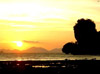
The place to catch the sunset is at Coco’s very comfortable bar, right in the middle of the beach. This, the only bar on West Railay, is always a quiet one and has to be a candidate for being southeast Asia’s best beach bar.
|
After sunset West Railay beach starts to empty and by midnight it is usually almost completely deserted, except for the occasional party of illicit skinny-dippers, enjoying a dip au naturel at the northern end of the beach, where there are no resorts and so no people around.
Midnight swims, au naturel or otherwise, are sensational on dark nights, when the brilliant-blue bioluminescence in the water lights up disturbed water like a neon-lit Christmas tree. To best appreciate this amazing phenomenon, bring a pair of swimming goggles along and swim underwater for a while: the bioluminescence will wreath your body in a million tiny blue lights, in surely the loveliest clothes you’ve ever worn.
East Railay Beach
Mangrove-lined East Railay beach is where you will find the budget accommodation and the nightlife, which is lively and wholesome, due to the absence of any girly bars. Well worth a visit is the Diamond Cave, a deep grotto lined with stalactites that sparkle so much that they look like they’re covered in diamonds. During the daytime East Railay can not compare in beauty to either West Railay or Phra Nang, but at night the mangroves look very pretty, and the huge lit-up rock-faces lend the scene a spectacular back-drop.
Ton Sai beach
This budget beach houses southeast Asia’s densest population of rock-climbers, and is the peninsula's budget hotel centre. If you don’t climb then you won’t enjoy staying here, as the climbers never talk about anything except climbing and many of them look down their noses at non-climbers and anyone over the age of twenty-five. The density of the budget accommodation here has led to the worst sanitary environment of any beach in Thailand. Many Ton Sai residents stay for months at a time and most of them at some stage in their visit get food-poisoning, which can be serious, with hospital evacuations not uncommon. Jane, 31, from Australia writes:
“Before I had even finished eating the salad I felt sick and had to rush to the toilet to vomit. My boyfriend, who managed to keep his food down and only started to throw up the next day, subsequently suffered more than me, as the food had had longer to poison him than it had had to poison me.”
Visitors who want to walk over to Tonsai from West Railay in order to watch the climbers for an hour or two are advised to do it on a full stomach, in order to avoid the need to patronize the Ton Sai restaurants. A short visit to Ton Sai is recommended, as it is a unique opportunity to watch, up-close, the antics of some of the world’s best rock climbers, whose gravity-defying gymnastics are simply amazing. Don’t be surprised if, when sitting at the Freedom Bar watching the action, a climber abseils into the chair next to you, stretches a bit, then orders a beer.
Activities
Climbing

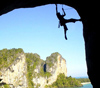
Railay is arguably the best bolted winter rock climbing area in the world, with over seven hundred bolted routes up limestone faces with breathtaking views over the ocean. There are only a few routes suitable for beginners, which get very crowded during the high season, so beginners are advised to take their introductory course on Koh Phi Phi, which has a greater number of easy routes.
Click here for prices, and more info on the climbing.
Kayaking
The kayaking around the peninsula at Railay affords a less strenuous way than climbing to get up close to the sensational scenery. Several of the limestone islets off Phra Nang beach have sea caves eroded into their bases, including a few large enough to beach a kayak in. Paddling into caves and through subterranean passages is particularly interesting, but watch out for low, jagged ceilings. For those with more ambition, a short open-water crossing (about one hour of steady, heavy paddling) leads to the island of Koh Poda, which has beautiful and relatively isolated beaches, plus some decent snorkeling. A bottle of water, a hat and plenty of sun protection are essential. Kayaks can easily be rented after arrival.
Trekking
Superlatives fail when attempting to describe Railay, when seen from above. A fact that most visitors never become aware of is that you don't need to be a rock climber to get fairly high above the beaches. The only gear you need is a stout pair of sandals.
The easiest trek is to go to Phra Nang beach, then walk all the way to its northern end. The enormous rock pillar in front of you and separating you from West Railay beach is called the Thaiwand Wall, and is hollow. You can trek right through it to the West Railay side. All you have to do is follow the other people who will be going the same way and you will eventually, after climbing fixed ladders and holding on to fixed ropes, emerge in a cave high above West Railay Beach.

You may recognise this view, as it appears in thousands of posters all over Thailand promoting Krabi province. Just don't forget to take two torches with you, as the hollow insides of the Thaiwand Wall are completely pitch black. Those terrified of bats should stay away. After retreating back to Phra Nang beach the way you came, you will want to jump straight in the water to wash off all the mud with which you will by this stage be covered. From the beach, up to the cave and then back down again takes less than an hour.
Take a change a clothing.
If the above trek has whetted your appetite, maybe you'd like to check out the Princess Lagoon too. On the right hand side of the path from Phra Nang beach to East Railay beach is a huge limestone karst. Like the Thaiwand Wall, this one is also hollow. Not hollow from side to side, like the Thaiwand wall, but from a large hole in the top down to a sea-level lagoon. Using fixed ropes you scramble up its slippery and muddy side and then, after following the right-hand of two trails, down into its middle, you come to a hidden glen where not a sound disturbs a silence so deep you can hear a leaf fall.
Descend further and you eventually reach the eerie Princess Lagoon. One of Thailand's most special places, the lagoon is breathtakingly beautiful, particularly when lit from below by turquoise light streaming in from an underwater window to the karst's exterior. Try not to step in, though, as the bottomless muck has quite an appetite for trekkers' footwear: you really don't want to have to climb back up barefoot. The last ten metres down to the lagoon require ropes when muddy and are dangerous even when dry. On the way out, trek back up to the point where the trails divided earlier and you took the right-hand trail. Take the other trail and after five minutes you will emerge at the "Low Viewpoint", which isn't so low and affords lovely views over the East beach.
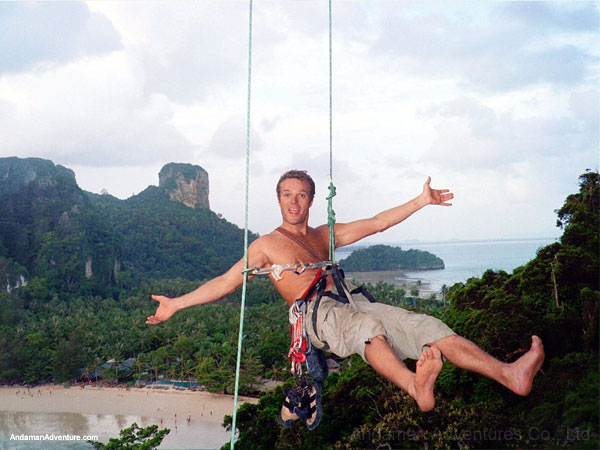
It is possible to climb right to the topmost point of the hollow karst, called the "High Viewpoint", but you need a guide and a rope. This is technically a rock climb as it requires a rope to ensure safety, but it is too easy a route to really qualify as rock climbing. This route is so easy it is virtually a staircase made of stone, and can be ascended by anyone fit enough to make it up the muddy scramble necessary to get to its base. From the top of this route you walk across dagger rock to the topmost point on the karst where, underneath you, is spread out the entire Railay peninsula, in a majestic panorama of peaks, palms and beaches. This is one of the best and most easily accessible views of Railay. Almost anyone can get to see it but few ever do, as guides don't like the muddy scramble to its base, so don't encourage clients to ascend it.
We offer a guided trekking/climbing day-trip to Railay - click here for more.
Island-Hopping and Snorkelling
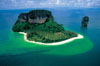
Railay is a good place from which to take an island-hopping and snorkeling trip to the lovely and strangely-shaped nearby islands. Tup Island is a favourite. These trips can easily be booked after arrival.
Scuba Diving
Click here for Krabi diving
Resorts
There are only 15 resorts and hotels on Railay, so it fills us quickly in the high season. If stuck for a place to stay, or averse to crowds, stay in a hotel in nearby Ao Nang instead, and visit Railay on day-trips.
The Railay Bay Resort and the Railay Village are the best hotel choices for travellers with fairly deep pockets, but not deep enough to cover the stratospherical prices at the Rayavadee. The Sunrise Tropical hotel offers the best value quality rooms on the peninusula, and the Railay Princess resort is another good mid-range choice. Travellers on tighter budgets who still want a pool should stay at the Diamond Cave Resort hotel or the Diamond Cave Private Resort, whilst the Highlands hotel offers by far the best value budget accommodation on the peninsula.
Click on a resort for more info:
Click here for Krabi hotels
|